

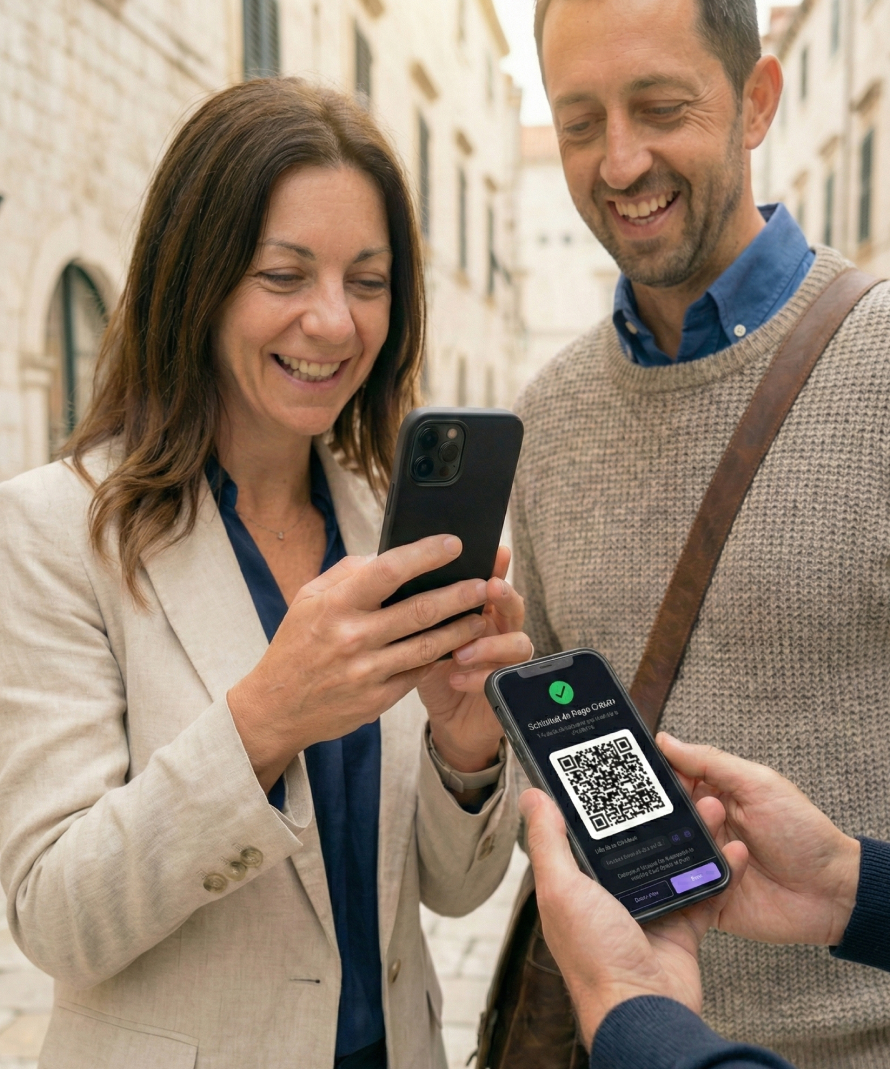
You spend two weeks selling a $3,500 Galapagos tour over WhatsApp. Photos, itinerary changes, a hotel upgrade, a discount for booking this month. The customer finally says yes. Then you send wire instructions, and the conversation goes quiet. Three days later they are "still going to the bank." The sale did not die because of the price. It stalled because paying was harder than buying.
Payment links for travel agencies exist to close that gap. The customer says yes in the chat, you send a link in the same chat, and they pay from their phone in the time it takes to type a card number once. This guide covers what a payment link is, why the alternatives quietly cost you sales, what a good link looks like for a high-ticket trip, and the simple workflow that turns "yes" into money in the account.
Payment links for travel agencies, in plain English
A payment link is a secure web address you send to a customer that opens a checkout page for a specific amount, so they can pay you online without your business having a website store. You create it in seconds, send it through any channel, and the customer pays with a card or a local payment method from wherever they are.
To see why this matters for travel specifically, look at how you actually sell trips. Almost never through a cart on a website. A honeymoon to Punta Cana starts with a DM. A $6,000 family package to Orlando gets built over five phone calls. A corporate retreat gets quoted by email with three revisions. You sell trips over the phone and over WhatsApp because trips are personal, expensive, and full of questions. The conversation is the store.
The payment step should live where the sale lives. Every time you force a channel switch, from the chat to a bank branch, from the phone call to a mailed invoice, you give the customer time and friction. Time to compare, to doubt, to consult a cousin who "knows a cheaper operator." With a link, the distance between "yes" and "paid" is one tap.
The old ways to get paid, and where they leak
Most agencies collect high-ticket payments in one of three ways. Each one loses you something.
Card numbers dictated over the phone
The customer reads their card number out loud, you type it into a terminal or write it on a notepad. It feels fast, but it is the riskiest option on this list. Card data handled this way falls under PCI DSS, the card industry's security standard that governs how any business that touches card numbers must store and protect them. A number written in a notebook, saved in a spreadsheet, or sitting in your WhatsApp history is a compliance problem and a breach waiting to happen. It also produces card-not-present charges with none of the protections, which means when a dispute arrives, you have little evidence that the cardholder authorized anything.
Bank transfers and wires
Wires feel safe to you and scary to the buyer. From the customer's side, sending $4,200 to an account number they cannot verify, with no recourse if something goes wrong, is a leap of faith. Many hesitate, and hesitation kills bookings. From your side, transfers are slow to arrive, sometimes days for international ones, and painful to reconcile. Reconciling means matching each deposit in your bank statement to the sale it belongs to, and with wires that means deciphering truncated sender names and chasing customers for screenshots of the transfer receipt.
Cash and office visits
Cash works until you want to grow. It limits you to customers who can physically reach you, which rules out the traveler in another city, the family abroad paying for a relative's trip, and every cross-border customer you could be serving. It also leaves no automatic record, so every payment depends on someone writing it down correctly.
The customer who has to visit a bank to pay you is comparing you, one more day, against every competitor with a checkout that fits in their pocket.
Anatomy of a good payment link for a $3,500 tour
Not all links convert equally. When the amount is high, the checkout page has one job: to look exactly like what the customer already agreed to. For a $3,500 Machu Picchu tour for two, a good link shows four things.
The exact amount
$3,500.00, not "enter amount." The customer approved a specific number in the conversation. Seeing the same number on the payment page confirms they are in the right place and prevents typos that turn $3,500 into $350 or $35,000.
A description that matches the trip
"Machu Picchu tour, 5 days, 2 travelers, departing Oct 12." One line is enough. This does two jobs: the customer recognizes the purchase at checkout, and months later, when they see the charge on their statement, the paper trail already says what it was for. That recognition prevents disputes.
The business name the customer knows
If the customer has been chatting with "Andes Travel" for two weeks and the payment page says "Grupo Inversiones RM S.A.", they will stop. Some will ask, and some will just not pay. The name on the checkout, and ideally the name on the card statement, should be the brand they have been talking to.
An expiry date
A link that expires in 48 or 72 hours does two useful things. It protects your pricing, because the fare you quoted will not hold forever. And it gives the customer a soft, honest reason to decide now, without you having to push.
One more habit worth building: one link per booking, never a reused generic link. A unique link ties the payment to the reservation automatically, which pays off in the operations section below.
Cross-border buyers abandon checkouts that feel foreign
If you sell to travelers across the Americas, some of your buyers are in Mexico, Colombia, Brazil, or Argentina, holding local cards and thinking in local currency. For them, a checkout priced only in US dollars, accepting only US-style payment, is a wall.
Currency is the first stumble. A buyer in Bogota who sees "$3,500 USD" starts doing mental math with an exchange rate they are not sure about, plus a foreign transaction fee they cannot predict. Uncertainty at the moment of payment is where checkouts tend to die. A link that can show the price in their currency removes the math.
Payment method is the second. In much of Latin America, the way people pay large amounts online is not always a credit card with a high limit. Local cards, bank-based payment methods, and installments are normal. A checkout that accepts the way your buyer already pays converts better than one that asks them to find a different instrument, and while exact numbers vary by market, anyone who sells cross-border learns quickly that unfamiliar checkouts get abandoned more.
The practical upshot: when you collect payments over WhatsApp from an international customer, the link you send should adapt to them, their language, their currency, their methods. You keep selling in one conversation, and the checkout does the localization for you.
Operational wins, and what the customer sees
Payment links do quiet work on both sides of the transaction.
On your side: reconciliation stops being detective work
Because each link is tied to a booking, every payment arrives already labeled. You open your dashboard and see who paid, how much, for which trip, and when. No more matching bank deposits against a list of pending sales. No more asking customers to send a screenshot of their transfer as proof, and no more judging whether a screenshot is real. When a customer pays a $1,800 deposit on a $5,400 package, the balance due is visible instead of living in someone's memory.
That record also becomes your evidence file. If a payment is ever disputed, you can show what was purchased, for how much, and that the cardholder completed a secure checkout, which is a far stronger position than a dictated card number ever gives you.
On their side: the signals that make paying feel safe
A high-ticket payment is an act of trust, and the checkout page is where the customer decides whether to extend it. What they see matters: a padlock and an https address, meaning the connection is encrypted; the logos of card networks they recognize; your business name and the trip description, matching the conversation; and often a verification step from their own bank, called 3D Secure, where the bank confirms it is really them, usually with a code in their banking app. None of this exists when they are reading a card number to you over the phone. All of it exists on a proper payment link, and the customer can feel the difference.
The workflow: quote, link, confirm, deliver
Here is the whole rhythm, using a $2,800 Riviera Maya package as the example.
- Quote in the conversation. The customer asks, you build the trip in the chat or on the call, and you land on a number: $2,800, all inclusive, two travelers, departing March 3. Get an explicit yes to that exact figure.
- Send the link in the same channel. Create a link for $2,800 with the trip description and a 72-hour expiry, and drop it into the WhatsApp thread where the yes just happened. No channel switch, no forms to email.
- Let confirmation happen automatically. The customer pays from their phone. You get notified the moment the payment clears, the booking is marked paid, and nobody has to ask "did the transfer arrive?"
- Deliver the documents. With payment confirmed, send the itinerary, vouchers, and confirmations to the same conversation and to email. The customer paid, received, and never left the chat.
The entire cycle can happen inside an afternoon. Compare that with the wire version of the same sale: instructions sent, a bank visit promised, a receipt screenshot requested, a deposit hunted down in the statement two days later. Same trip, same customer, very different week.
The short version
- Sell where the conversation is, and get paid there too. A channel switch at the payment step is where high-ticket sales stall.
- Never handle raw card numbers by phone or chat. It is a PCI compliance risk and it leaves you exposed in disputes.
- A good link shows the exact amount, the trip, a name the customer recognizes, and an expiry.
- Local currencies and payment methods are what make cross-border buyers actually complete the checkout.
If your sales already live on WhatsApp, on the phone, and in email threads, you do not need a bigger website. You need the payment step to move at the speed of the conversation. That is the whole idea.
Aloha gives travel agencies payment links built for high-ticket sales, with local currencies and methods for travelers across the Americas.